
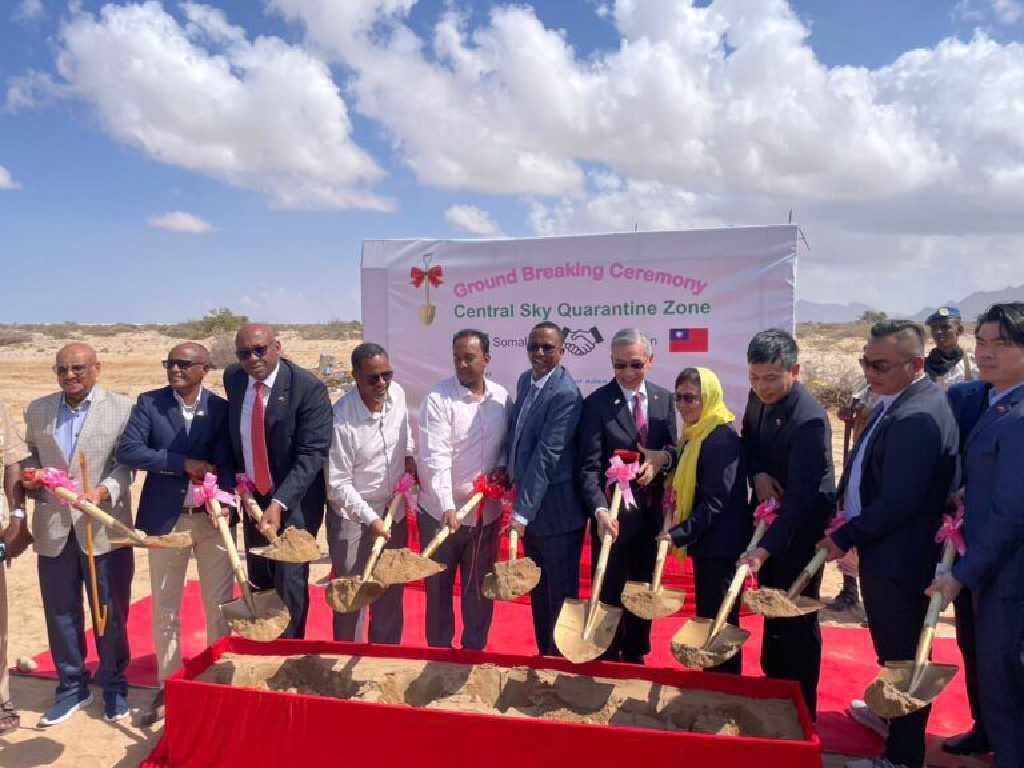
On 25 December 2025, construction began on one of the most significant infrastructure investments in Somaliland’s agricultural sector. The Central Sky Quarantine Zone – a US$20 million livestock quarantine and export management facility on 88 hectares near Berbera Port – broke ground at a ceremony attended by Somaliland government ministers, regional officials, and a delegation of Taiwanese and international investors.
The project is led by Central Sky International Trading Co., a Taipei-based agricultural trading and supply chain company. It marks Taiwan’s first large-scale private investment in Somaliland, and the first joint private-sector venture in Somaliland to bring together investors from three different countries: Taiwan, Saudi Arabia and the United States.
What is Being Built
The Central Sky Quarantine Zone in Berbera is designed as more than a holding pen for animals awaiting export clearance. The facility’s ambition, as outlined by its developers, is to serve as a comprehensive hub for livestock quarantine, digital traceability and export management — combining infrastructure, technology and certification under one system.
Alyne Chen, General Manager of Central Sky International Trading Co. and Chair of the Taiwanese Business Association in Somaliland, outlined plans for Taiwanese technologies to be embedded throughout the facility: solar photovoltaic power generation, electronic livestock identification, and waste treatment systems.
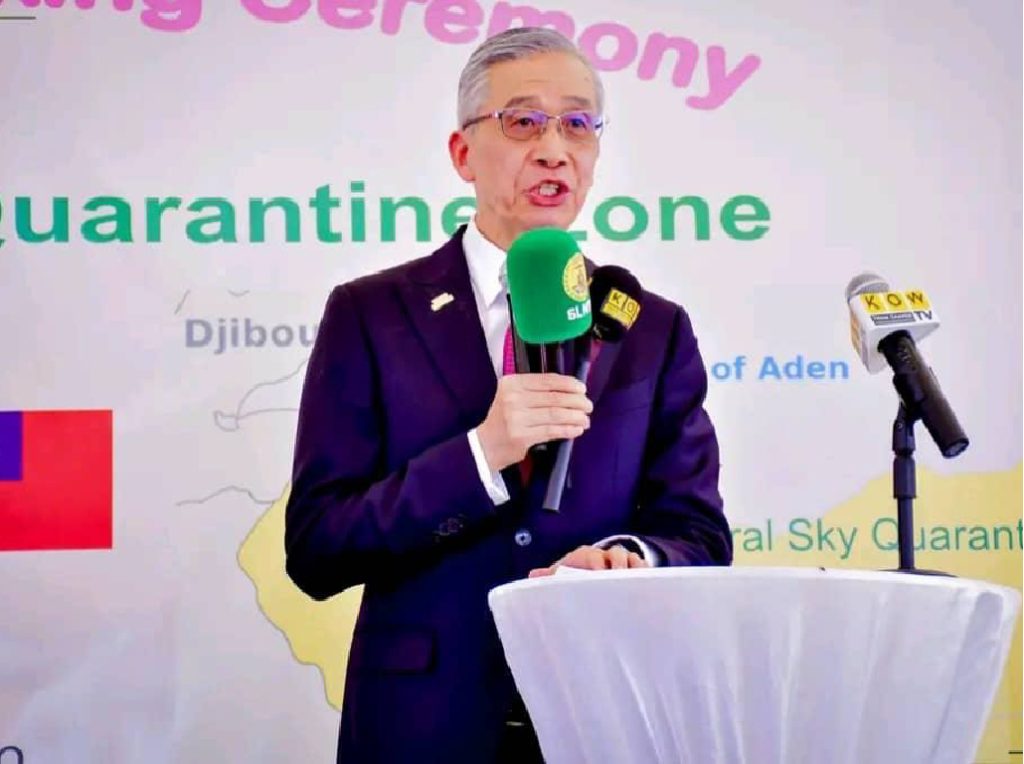
The groundbreaking brought together a senior lineup of Somaliland officials. Omar Shueb Mohamed, Minister of Livestock and Rural Development, laid the foundation stone and used the occasion to frame the facility’s strategic importance: the project, he said, would ‘help align Somaliland’s livestock exports with international quarantine and sanitary standards, reinforcing Berbera’s role as a regional livestock trade hub’. The land was formally allocated by Berbera’s local government following a request from the Ministry.
Also present were Abdiqani Mohamed Aateeye, Governor of Sahil Region; Abdishakur Mohamood Hassan, Mayor of Berbera; and Mohamoud Galal, Somaliland’s Ambassador to Taiwan, who described the investment as high-tech in nature, employment-generating, and reflective of the strength of the bilateral relationship between Somaliland and Taiwan. Taiwan’s Ambassador to Somaliland, Allen Chenhwa Lou, attended and emphasised that the project represented not only Taiwan’s first major private investment in Somaliland, but a genuine joint business venture across three investor nationalities.
The construction timeline is phased. Phase 1 runs from early 2026 through the third quarter of the year, followed by operational testing in the second half of 2026. Official operations are currently targeted for early 2027.
Why Quarantine Infrastructure Matters
To understand the significance of this facility, it helps to understand what its absence has historically cost Somaliland.
Livestock is the backbone of Somaliland’s economy as it contributes an estimated 60 to 70 percent of the country’s export earnings and employs the majority of its rural population — pastoralists, traders, port workers, veterinary staff and a wide range of service providers whose livelihoods run through the same supply chain that ends at Berbera Port. Between 3 and 3.5 million animals pass through Berbera annually, destined primarily for Saudi Arabia, the UAE, Qatar and Oman. Around 70 percent of sheep and goat exports flow to Saudi Arabia, with the Hajj season representing the single largest volume spike in the calendar.
That concentration of export dependency — one product, one port, a handful of markets — has exposed Somaliland to severe shocks when things go wrong. Two Saudi import bans, imposed on disease grounds, devastated the sector for extended periods and left pastoralist communities without their primary source of income. The bans revealed a structural weakness: in the absence of internationally certified quarantine and biosecurity infrastructure, Somaliland’s livestock exporters have had limited recourse when an importing country raises health concerns. Certification, traceability and documented biosecurity protocols are the mechanisms through which such disputes are resolved — and Somaliland has lacked a facility capable of providing them at scale.
The November 2025 issuance of a national-level livestock quarantine licence to Central Sky International — the first such licence in Somaliland’s history — began to address that gap in regulatory terms. The December groundbreaking begins to address it in physical ones.
Somaliland’s livestock sector — key figures
| Indicator | Figure | Source |
|---|---|---|
| Livestock contribution to export earnings | ~60–70% | Somaliland Ministry of Investment |
| Annual exports through Berbera Port | ~3–3.5 million head | SomalilandBiz Livestock Sector Guide |
| Primary market | Saudi Arabia (~70% of sheep/goat exports) | Pastoralism Journal |
| Horn of Africa-wide livestock exports | ~US$974m (2024), approaching US$1bn | Somalia Development and Reconstruction Bank |
| Gulf region sheep/goat imports | ~US$2.4 billion (2024) | Feed Business MEA |
The Market Moment
The timing of this investment is most notedly significant. Two big supply-side disruptions have reshaped the global market for live animal exports in recent years, and both have worked in Somaliland’s favour.
Sudan, historically one of the Gulf’s major livestock suppliers, has seen its export capacity severely diminished by ongoing civil conflict. Australia, the other dominant supplier of sheep to Gulf markets, has been progressively scaling back its live animal exports in response to domestic animal welfare policy. The gap left by both has been substantial: Gulf states imported roughly US$2.4 billion worth of sheep and goats in 2024 alone, and demand shows no sign of contracting.
Somaliland sits closer to those markets, geographically, than almost any other major supplier. Animals exported through Berbera can reach Saudi ports quickly and with lower transport stress than those shipped from further afield — a genuine competitive advantage in a trade where animal welfare on arrival is increasingly scrutinised by buyers. The constraint has not been demand or geography but rather it has been the absence of internationally recognised biosecurity and traceability infrastructure that would allow Somaliland’s exporters to confidently compete for the premium, high-volume tiers of Gulf demand.
The Central Sky quarantine zone is a direct response to that constraint.
The Investor Structure and What it Signals
The multinational character of this investment deserves attention. A joint venture between Taiwanese, Saudi and US private investors in a single project in Somaliland is unprecedented.
Each investor nationality brings a different logic to the table. The Taiwanese investors bring operational expertise in agricultural supply chains and the technology ambition that underpins the facility’s design. Saudi capital in a livestock export facility that serves Gulf markets is a straightforward alignment of interest — buyers investing in the infrastructure that improves the quality of their supply. US private capital signals risk appetite and a view on Somaliland’s long-term commercial trajectory that goes beyond a single sector.
The project was also directly endorsed by President Irro, who described it as a pivotal step toward building a globally competitive livestock supply chain. That presidential-level endorsement — combined with the formal land allocation by Berbera’s local government and the presence of the Ministry at the groundbreaking — reflects a degree of institutional coordination that matters to international investors weighing sovereign risk. This was not a project quietly approved at a desk; it was publicly backed at the highest level of government.
Our View
The Central Sky quarantine zone is significant for three reasons that go beyond the facility itself.
The first is structural. Somaliland’s livestock sector has long carried a vulnerability that the Saudi bans exposed with painful clarity: an economy heavily dependent on a single export channel. A modern, certified quarantine facility with electronic traceability changes that calculus. It does not eliminate risk — droughts, disease and market shifts remain real — but it removes one of the most significant barriers to Somaliland competing at the premium end of Gulf livestock demand.
The second is the signal the investor structure sends. Private capital from Taiwan, Saudi Arabia and the United States reaching the same conclusion about Somaliland’s viability as an investment destination is a data point that matters. International investors do not announce joint ventures in frontier markets for symbolic reasons. They do it because they believe the numbers work and the risk is manageable.
The third is the ambition behind the facility. Central Sky has described the project not as a basic quarantine facility but as an industrial showcase for Taiwanese technology and management expertise, with commitments to hire and train local staff in veterinary technology, digital data systems and supply-chain management, and to partner with local universities and technical institutes. If that vision is delivered, the facility has the potential to become a model for the kind of value-added agri-infrastructure that can shift Somaliland from a raw livestock exporter to a more sophisticated node in the Gulf food supply chain.
The honest caveat is the one that always applies at groundbreaking stage: construction must be completed, operational testing passed, and international certification secured before any of this becomes a functioning reality. Early 2027 is the target. Between now and then, the project will face the usual challenges of building in a frontier market — logistics, supply chains, local capacity. But we are confident and optimistic that this facility will be completed and meet it’s lofty ambitions.
As with all major infrastructure and business news in Somaliland, we will keep you posted and updated here. Somaliland ha noolato (Google that if you don’t understand 🙂