
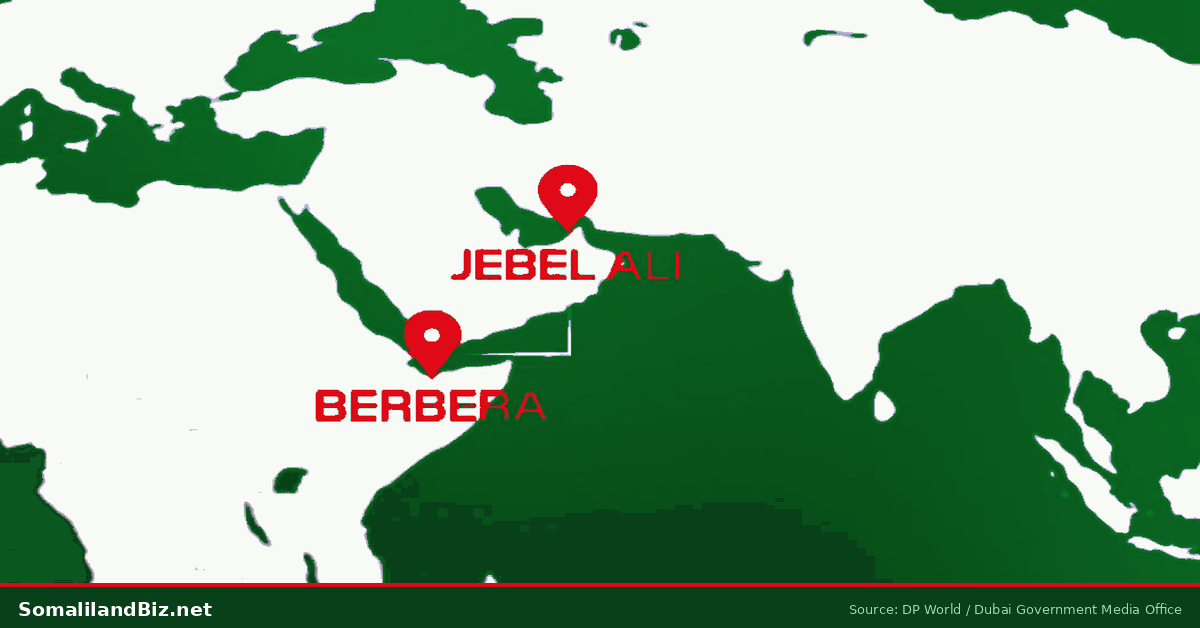
DP World announced on 16 October 2025 that it has launched a new direct shipping service linking Jebel Ali Port in the UAE with Berbera Port in Somaliland. The service runs every nine days and calls at Aden and Djibouti along the way, giving Berbera a scheduled, regular connection to one of the world’s busiest container hubs for the first time.
For Somaliland, the announcement is straightforward good news. For anyone tracking the broader commercial logic of Berbera’s development, the more interesting question is what the route is really for – and the answer points not only to the UAE but to Ethiopia.
What the Service Involves
The Jebel Ali–Berbera route calls at Aden (in Yemen) and Djibouti, linking Berbera into DP World’s wider regional network and giving shippers access to onward connections across the Horn of Africa. From Berbera, cargo can move inland toward Ethiopia, providing an alternative to the overland logistics chains that currently route almost all of Ethiopia’s international trade through Djibouti Port.
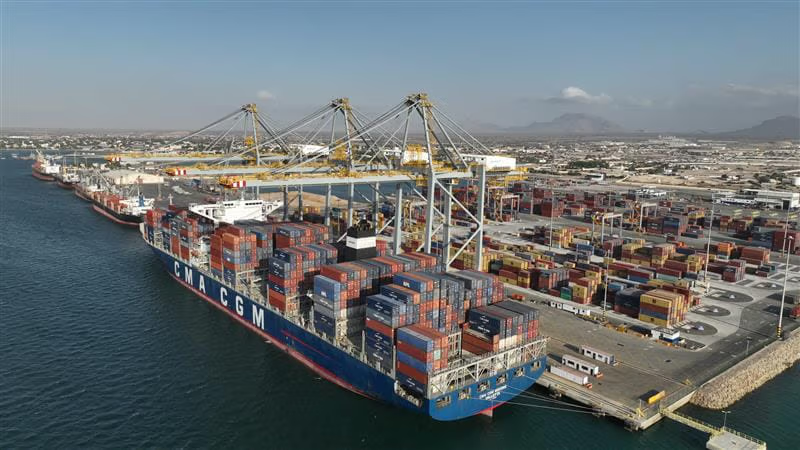
Berbera’s infrastructure has been substantially upgraded to support exactly this kind of service. The port now operates a 1,050-metre quay, including a 400-metre berth capable of handling Triple E vessels – the largest class of container ships in service. It is home to the region’s most modern container terminal, with annual capacity of 500,000 TEUs and expansion plans targeting two million. Bulk, breakbulk and livestock facilities are also in place, with more than 4.1 million livestock passing through the port annually to Gulf markets, a trade now valued at over US$1 billion a year.
Since DP World began operations at Berbera in 2017, the port’s transformation has been measurable. Vessel productivity has risen by 450% Container volumes are up 30%. General cargo throughput has grown by 90%. The port now handles more than 14 container vessels per month.
The Ethiopia Dimension
The direct route matters also as an Ethiopia story. This is because Ethiopia is a landlocked country of more than 130 million people that relies on Djibouti for almost all its international commerce. That concentration creates a structural vulnerability for one of Africa’s largest economies – when Djibouti is congested, or when political relationships shift, Ethiopia’s supply chains feel it.
Berbera is the most credible alternative as the port sits closer to the Ethiopian border than Djibouti’s main terminal, and the road corridor connecting Berbera to Addis Ababa — upgraded with support from the Abu Dhabi Fund for Development and the UK’s FCDO, including a 250km road project and the 22.5km Hargeisa Bypass — is progressively improving. In 2021, DP World signed a memorandum of understanding with Ethiopia’s Ministry of Transport aimed at developing the Ethiopian side of the corridor, envisaging dry ports, warehouses, container yards and cold-chain depots along the route.
The new shipping service does not immediately resolve the Ethiopia question — Djibouti still handles the overwhelming majority of Ethiopian trade, and the corridor still requires further investment and political alignment to reach its potential. But a scheduled, every-nine-days direct service from Jebel Ali to Berbera gives importers and exporters a concrete, timetabled option that did not previously exist.
Ganesh Raj, Group Chief Operating Officer, Marine Services at DP World, put the strategic framing plainly: “The Jebel Ali to Berbera service further complements DP World’s investment drive into Africa. Building on the significant infrastructure we have developed across the continent, the service enhances connectivity for our customers as we continue to boost trade links between the Middle East and East Africa.”
Supachai Wattanaveerachai, CEO of DP World Horn of Africa, added: “The launch of this new corridor is a milestone in our ambition to build faster, safer, and more reliable trade routes. It reflects our commitment to creating meaningful economic benefits for businesses and communities in the region.”
The Timing is Worth Noting
The route launched in mid-October 2025, in the aftermath of a sustained period of Houthi attacks on Red Sea shipping that pushed global carriers to reroute vessels around the Cape of Good Hope and prompted a reassessment of the Gulf of Aden’s value as an alternative corridor. Berbera sits directly on the Gulf of Aden approach — on the southern side of the strait, away from the primary Houthi targeting zone in the Red Sea proper. The disruption that damaged Red Sea routing simultaneously made the case for Gulf of Aden alternatives more commercially compelling than at any point in recent memory. Launching a Jebel Ali–Berbera service at precisely this moment was not coincidental.
Beyond the Route
The Berbera Special Economic Zone, developed alongside the port, is designed to capture the investment and industrial activity that port traffic generates — warehousing, light manufacturing, logistics services, and the broader commercial activity that follows predictable trade flows. The zone is the bet that Berbera becomes not just a transit point but a business address.
Community investment has also accompanied the commercial development. DP World’s initiative training the region’s first female solar-energy technicians — the “Solar Mamas” programme — has received attention as an example of infrastructure investment with a deliberate social dimension.
Our View
A scheduled direct link between the world’s third-busiest container port and Berbera is very good news and a clear indication of progress. Port routes are generally not exciting announcements but for Somaliland it is. We have long reported on the progress of the DP World Berbera deal and with every milestone, every developmental piece of news, things are moving forward with great optimism. The launch of this service continues a trajectory that has been building for nearly a decade: incremental but consistent steps that make Berbera more competitive, more connected and more commercially credible.
The Ethiopia dimension is the long game, and it is the one to watch. If Berbera can capture even a meaningful share of Ethiopian trade currently flowing through Djibouti, the economic implications for Somaliland are transformative. The new Jebel Ali service is one more piece of the infrastructure needed to make that happen.
Sources: Dubai Government Media Office (official announcement, 16 October 2025); Ship Management International; Maritimafrica; NTU-SBF Centre for African Studies; Logistics Middle East; Log Update Africa. Performance figures sourced from DP World’s official statement.